Hiking food, meal planning and the lessons I've learnt from more than a decade of outdoor adventures.
I like to say that hiking is just a series of beautiful picnics. A morning coffee (yes, I go with instant!) overlooking the water, lunch beside a creek, a handful of snacks while admiring the view, and a warm dinner after a big day on the trail.
My Meals are often the thing I most look forward to on a day on the trail, but when you're spending several days walking with everything you need on your back, there's a little more to hiking nutrition than throwing a few muesli bars into your pack and hoping for the best.
You need enough energy to keep walking, enough nutrients to support recovery and food that is practical to carry, prepare and eat in the conditions you're heading into, and ideally, you want it to taste pretty bloody good too!
After more than a decade working in outdoor education and adventure guiding, I've learnt a few lessons about hiking food; some through training, some through experience, and some through soggy mistakes.
Here are the things I think are worth considering when planning food for your next multi-day hike.
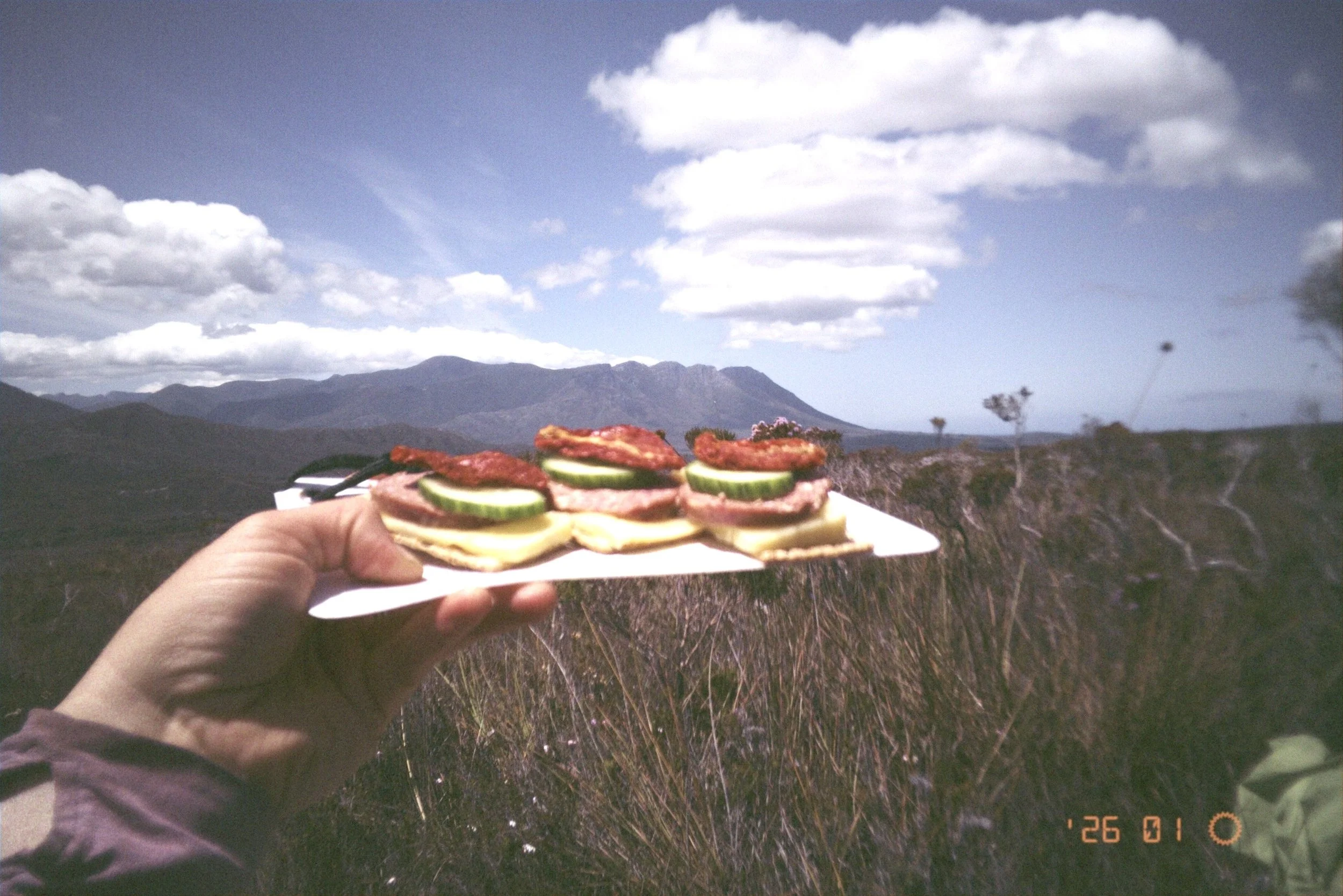
Trail lunch in South-West Tassie last January. Crackers hit different with a view!
1. starts with understanding your body's energy needs
Walking for six or eight hours a day, carrying a loaded backpack and negotiating hills, rocks and uneven terrain requires a lot more energy than most of us use sitting at a desk. While you might be tempted to focus entirely on keeping your backpack as light as possible, food is not the place to make drastic weight savings at the expense of your body's needs.
It’s worth understanding the three macronutrients:
Carbohydrates: Your body's readily available fuel for walking, climbing and sustained physical activity. Think oats, rice, noodles, couscous, crackers, dried fruit and energy-rich snacks.
Protein: Important for satiety, muscle repair, and recovery...particularly when you're asking your body to walk long distances over consecutive days. Think nuts, tuna, chicken, legumes, tofu and protein-rich hiking meals.
Fats: A concentrated source of energy that can be particularly useful when you're trying to carry enough calories without excessive food weight. Think nuts, nut butter, olive oil and seeds. (Also, fat is our body's primary fuel source during aerobic exercise like hiking).
You also need adequate fluids, and depending on the temperature/ your sweat losses/ the duration of your hike, you may need to pay attention to sodium and other electrolytes (me on every hike because I'm a sweater!).
There's no single calorie target that suits every hiker because your needs depend on your body, pack weight, terrain, walking duration, pace and environmental conditions. The important thing is to plan intentionally rather than assuming your normal daily food intake will be sufficient.
2. Choose foods that provide plenty of energy for their weight
When you're carrying everything on your back, the relationship between food weight and energy becomes important. Some foods are heavy because they contain a lot of water. Others provide substantial energy in a small package. This doesn't mean you need to abandon fresh food entirely, but it does mean understanding the trade-offs. For example, I love taking fresh vegetables on a short overnight hike. A zucchini for dinner, a cucumber for lunch and some carrots for snacks are great! However, on a longer expedition, carrying multipla days' worth of fresh produce can become unnecessarily heavy. That's when dehydrated ingredients and freeze-dried meals become super useful.
My conversion to freeze-dried meals
I used to be a bit of a purist when it came to preparing hiking meals from scratch. For some reason, I thought it was better to pack broccolini, rice, textured vegetable protein, sauces, spices, dried mushrooms and tinned tuna than to buy a purpose-made hiking meal. Looking back, I'm not entirely sure why (maybe just pride and ego?!). I think I also associated freeze-dried meals with highly processed convenience food and assumed that cooking from scratch was automatically the healthier option, but then I discovered Radix Nutrition in Dwellingup Visitor Centre while hiking the Bibbulmun!
What changed my perspective was realising that a well-formulated freeze-dried meal can be a practical way to get substantial nutrition into a lightweight, convenient package. I now look at the nutritional information, ingredients, serving size and energy content rather than judging a meal simply because it comes in a packet. For longer hikes, the convenience of adding water to a nutritious meal instead of carrying and preparing a dozen separate ingredients can be a pretty worthwhile trade-off (plus.... no dishes!).
You can use my affiliate code EOA15 for 15% off Radix Nutrition meals.
Affiliate disclosure: I may earn a commission when you purchase using my code.
Of course, not every freeze-dried meal is nutritionally equivalent, and not every meal will provide enough energy for every hiker. Read the label and plan the rest of your day's food accordingly.
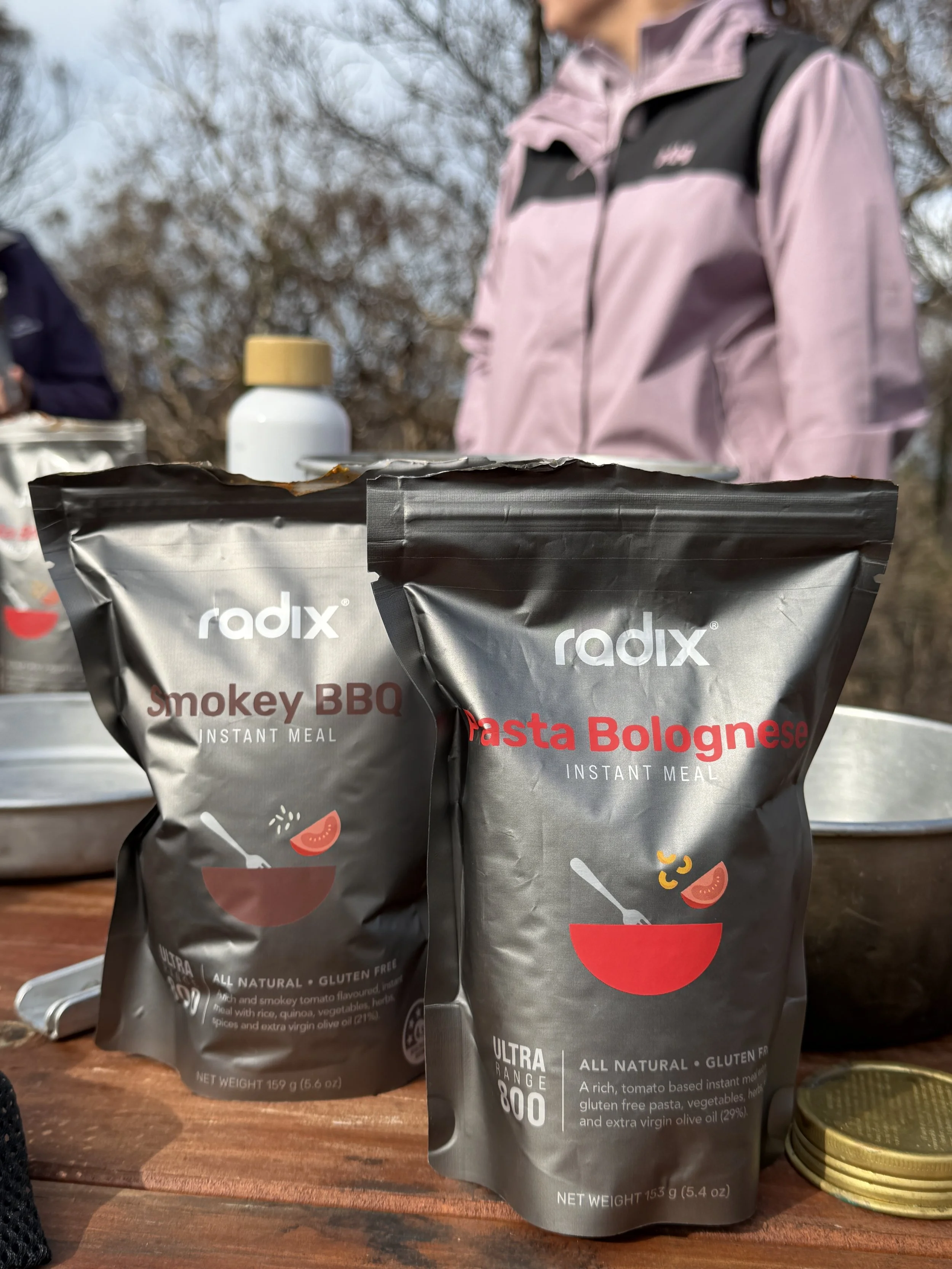
Some of our guests enjoying Radix on a Fleurieu Peninsula Hike.
3. Snacks are part of your fuel plan, not an afterthought
One of the easiest mistakes to make on a long hiking day is waiting until you're absolutely starving before eating. By that point, you might already be feeling tired, irritable or less focused. Instead, I prefer to think about food as something I need to replenish regularly throughout the day ( you might be familiar with my hourly hike routing.... hydrate, orientate, masticate - aka eat -, eliminate, celebrate).
This might mean a big bowl of protein oats for breakfast, dried fruit and nuts at walking breaks, a lunch of loaded vitawheats with cheese/ mettwurst/ cucumber/ sundried tomato, and sometimes a mid arvo protein bar to eat before the final stretch into camp, soup for entree, radix for dinner, and hot choc for dessert.
My love affair with nuts
One of the things I love about going on a personal hike rather than a school camp is that I'm allowed to pack nuts! Many school outdoor programs have nut restrictions because of allergies, but on my own adventures they're one of my favourite foods. Nuts provide energy-dense fats, some protein, flavour and crunch. Salted varieties can also contribute sodium. A squeezy pouch of peanut butter spread onto Vita-Wheats can turn a basic cracker lunch into something far more satisfying. Swirl some into your morning porridge and you've added extra energy, flavour and a different texture. Small additions that can make simple hiking food feel a little more substantial.
Why I carry lollies in my first aid kit
Here's something that might surprise you. I don't usually eat lollies in everyday life, but I carry a small packet of them in my hiking first aid kit. Why? Because sometimes you need a source of rapidly available carbohydrate. If someone is experiencing low blood glucose and is conscious and able to swallow safely, an appropriate amount of fast-acting carbohydrate can help raise it more quickly than foods containing substantial fat, protein or fibre (like a muesli bar). Glucose tablets or gel are more predictable options, but suitable glucose-based lollies can be cheap and work just as well. That said, feeling exhausted on a hike doesn't automatically mean you've got low blood sugar. Fatigue can have several causes, including inadequate food, dehydration, heat illness and overexertion.
Fast-acting sugar is a backup tool, not a replacement for eating enough throughout the day.
4. Hiking food doesn't need to be expensive
There's a misconception that you need an entire cupboard of specialised outdoor meals to go multi-day hiking, but you definitely don't! For a one or two-night hike, I'm quite happy creating simple dinners using supermarket ingredients.
Two of my favourites are:
Couscous, vegetables and tuna
An Ainsley's flavoured couscous sachet, fine fettle dehydrated vegetables and a small tin or pouch of tuna. It's simple, filling, cheap and requires minimal cooking.
Trail laksa
A Trident laksa packet, rice noodles, canned chilli chicken and a zucchini. It's warm, flavourful and filling after a big day walking.
Neither of these meals are particularly glamorous, but there's something so damn good about eating a steaming bowl of food while sitting outside your tent because everything tastes better after a full day of hiking.
For shorter trips, the additional weight of canned ingredients and fresh vegetables may be an acceptable trade-off for convenience and cost.
5. Think about packaging, storage and the environment
I've learnt this lesson the hard way. On my first sea kayaking expedition, I discovered that one of my hatch covers and a dry bag had leaked, resulting in soggy, salty fruitcake and muesli. Not exactly the delicious expedition snacks and breakkie I'd been looking forward to!
Since then, I've become much more deliberate about how I pack and protect my food. Your food storage system needs to suit the environment. On a sea kayaking expedition, waterproofing is obviously a priority. On a hiking trip, you still need to consider rain, condensation, crushed packaging, pests, food spoilage and how easily you can access snacks while walking.
A few things I consider when packing food:
Keep meals organised by day or meal type.
Protect ingredients from water and damage.
Consider food safety and spoilage, particularly in hot weather (cheese and salami are fine in cold climate hikes)
Check how much water and fuel your meals require.
Minimise unnecessary packaging before leaving home.
Plan to carry out all food scraps and rubbish.
And remember that the lightest food isn't necessarily the best choice if it's fragile, unpleasant to eat or requires more water than you can reliably access.
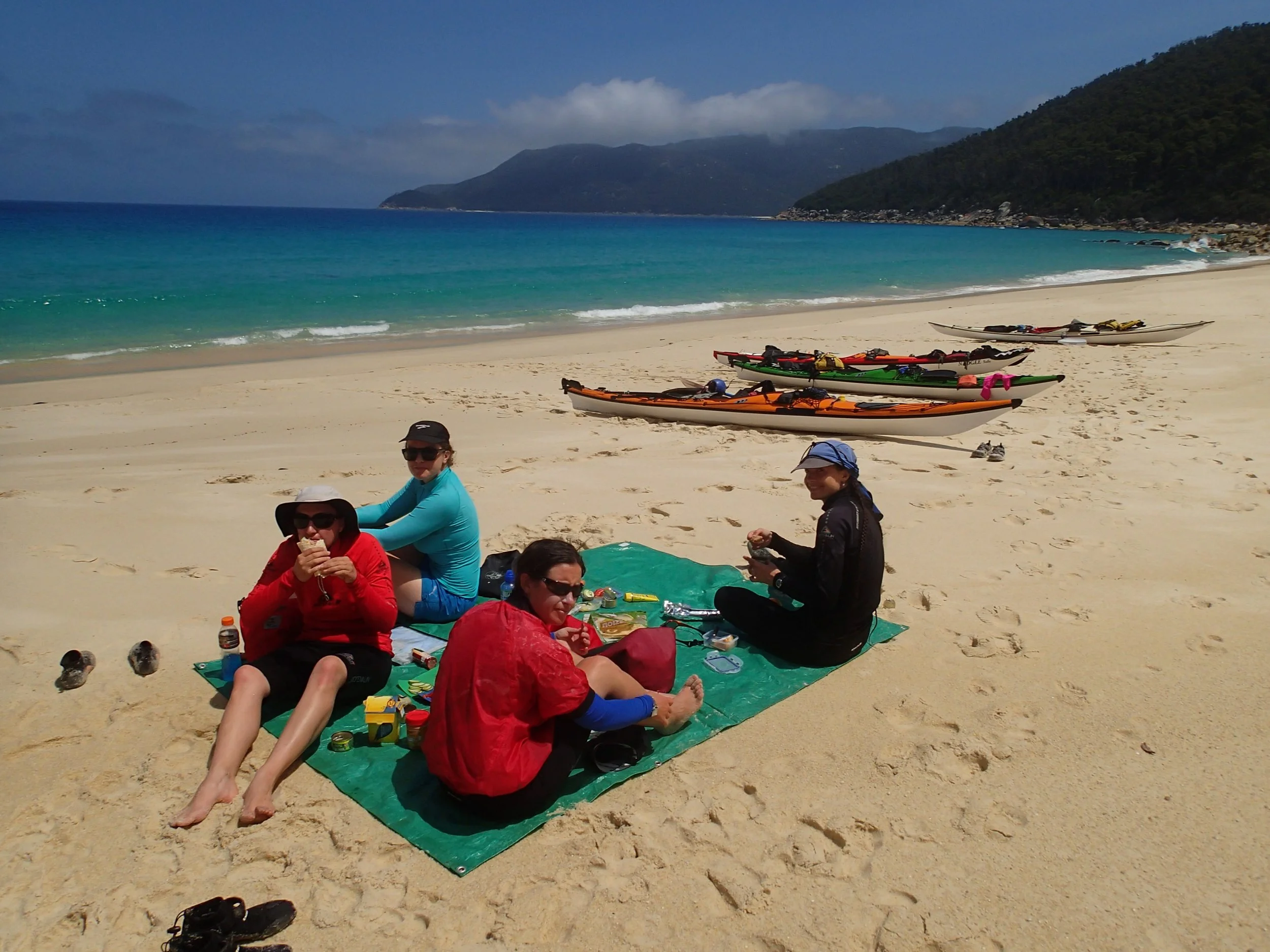
My disappointed face, realising my tucker was soggy at Wilson’s Prom, Vic.
6. Plan your water alongside your food
Water is one of the most important parts of multi-day hiking nutrition and it's also one of the heaviest things you'll carry. In case you didn't know, one litre of water weighs one kilogram, so understanding where you can safely replenish your supply can make a significant difference to your pack weight. But you should never assume that a creek, tank or water source marked on a map will be available when you arrive.
Seasonal conditions, drought, water quality and local management arrangements can all affect your plan. Before your hike, consider:
How much drinking water will you need between reliable sources?
How much water will you need for cooking?
Are the sources reliable at that time of year?
What water treatment method is appropriate?
What will you do if a planned source is unavailable?
7. Practise your meals before you leave
Here's a simple piece of advice that can save you a lot of frustration: Don't make the first night of your multi-day hike the first time you've tried cooking your dinner. Test your stove, Check the instructions, Work out how much water and fuel your meal needs, see whether the portion is satisfying, and most importantly, make sure you actually like eating it. The same applies to trail snacks. Food that sounds wonderful while you're shopping might be completely unappealing after several hours of walking in the heat.
Hiking nutrition is a skill you can learn
If you're new to multi-day hiking, food planning can feel like one more complicated thing to figure out. How much should you pack? What should you eat each day? How do you balance nutrition, weight, cost and convenience? What if you're still hungry? These are exactly the kinds of practical questions that we work through in Hike Ready, my 10-week online program helping adventurous women learn to plan, prepare for and take on their own multi-day hikes.
In Hike Ready, we explore hiking nutrition and energy management alongside the other skills that make independent adventures possible, including gear, physical preparation, navigation, weather, safety and trip planning.
It's all part of the Enliven Pathway:
Connection + Craft + Confidence = Capable.
Nutrition sits within Craft, the practical, teachable skills that help you look after yourself outdoors.
Because becoming a capable hiker isn't about memorising the perfect packing list.
It's about understanding what your body needs, making informed choices and knowing how to adapt your plans to different adventures.
And once you've learnt how to plan your own food, you'll be able to take that knowledge with you on every hike that follows.
So here's to many more beautiful picnics, spectacular views and delicious dinners eaten straight from the pot.
Ready to become your own guide?